3.EC2 -Elastic Cloud Compute
Amazon EC2 – = Infrastructure as a Service
It mainly consists in the capability of :
- Renting virtual machines (EC2)
- Storing data on virtual drives (EBS- Elastic Block Store)
- Distributing load across machines (ELB)
- Scaling the services using an auto-scaling group (ASG)
EC2 User Data
- It is possible to bootstrap our instances using an EC2 User data script.
- bootstrapping means launching commands when a machine starts
- That script is only run once at the instance first start
- EC2 user data is used to automate boot tasks such as:
- Installing updates
- Installing software
- Downloading common files from the internet
- Anything you can think of
- The EC2 User Data Script runs with the root user
EC2 Instance Types – Overview
Types of EC-2 instances optimised based on their use cases:
https://aws.amazon.com/ec2/instance-types/
AWS has the following naming convention:
m5.2xlarge
• m: instance class
• 5: generation (AWS improves them over time)
• 2xlarge: size within the instance class
EC2 Instance Types – General Purpose
Great for a diversity of workloads such as web servers or code repositories
Balance between:
• Compute
• Memory
• Networking
EC2 Instance Types – Compute Optimized
Great for compute-intensive tasks that require high performance
processors:
- Batch processing workloads
- Media transcoding
- High performance web servers
- High performance computing (HPC)
- Scientific modeling & machine learning
- Dedicated gaming servers
EC2 Instance Types – Memory Optimized
Fast performance for workloads that process large data sets in memory
Use cases:
• High performance, relational/non-relational databases
• Distributed web scale cache stores
• In-memory databases optimized for BI (business intelligence)
• Applications performing real-time processing of big unstructured data
EC2 Instance Types – Storage Optimized
Great for storage-intensive tasks that require high, sequential read and write
access to large data sets on local storage
Use cases:
• High frequency online transaction processing (OLTP) systems
• Relational & NoSQL databases
• Cache for in-memory databases (for example, Redis)
• Data warehousing applications
• Distributed file systems
Introduction to Security Groups
Security Groups are the fundamental of network security in AWS.They control how traffic is allowed into or out of our EC2 Instances

- Security groups only contain ALLOW rules
- Security groups rules can reference by IP or by security group
Security groups are acting as a “firewall” on EC2 instances
They regulate:
- Access to Ports
- Authorised IP ranges – IPv4 and IPv6
- Control of inbound network (from other to the instance)
- Control of outbound network (from the instance to other)
Good to know about Security Group
- Locked down to a region / VPC combination
- Does live “outside” the EC2 – if traffic is blocked the EC2 instance won’t see it
- It’s good to maintain one separate security group for SSH access
- If your application is not accessible (time out), then it’s a security group issue
- If your application gives a “connection refused“ error, then it’s an application error or it’s not launched
- All inbound traffic is blocked by default
- All outbound traffic is authorised by default
Classic Ports to know
- 22 = SSH (Secure Shell) – log into a Linux instance
- 21 = FTP (File Transfer Protocol) – upload files into a file share
- 22 = SFTP (Secure File Transfer Protocol) – upload files using SSH
- 80 = HTTP – access unsecured websites
- 443 = HTTPS – access secured websites
- 3389 = RDP (Remote Desktop Protocol) – log into a Windows instance
EC2 Instances Purchasing Options
- On-Demand Instances: short workload, predictable pricing
- Reserved: (MINIMUM 1 year)
- Reserved Instances: long workloads
- Convertible Reserved Instances: long workloads with flexible instances
- Scheduled Reserved Instances: example – every Thursday between 3 and 6 pm
- Spot Instances: short workloads, cheap, can lose instances (less reliable)
- Dedicated Hosts: book an entire physical server, control instance placement
- Dedicated Instances: no other customers will share your hardware
EC2 On Demand
- Pay for what you use:
- Linux – billing per second, after the first minute
- All other operating systems (ex: Windows) – billing per hour
- Has the highest cost but no upfront payment
- No long-term commitment
- Recommended for short-term and un-interrupted workloads, where you can’t predict how the application will behave
EC2 Reserved Instances
- Up to 72% discount compared to On-demand
- Reservation period: 1 year = + discount | 3 years = +++ discount
- Purchasing options: no upfront | partial upfront = + | All upfront = ++ discount
- Recommended for steady-state usage applications (think database)
Convertible Reserved Instance
- Can change the EC2 instance type
- Up to 45% discount
Scheduled Reserved Instances
- launch within time window you reserve
- When you require a fraction of day / week / month
- Commitment for 1 year only(365 day .must utilize 1200hrs)
EC2 Spot Instances
- Up-to 90% discount as compared to on-demand but can ‘lose’ instance if max price is less than usage
- Suitable for failure resilient tasks – batch process , not suitable for critical task like Db
EC2- Dedicated Hosts
Useful for software that have complicated licensing model (BYOL –
Bring Your Own License)
EC2 – Dedicated Instance
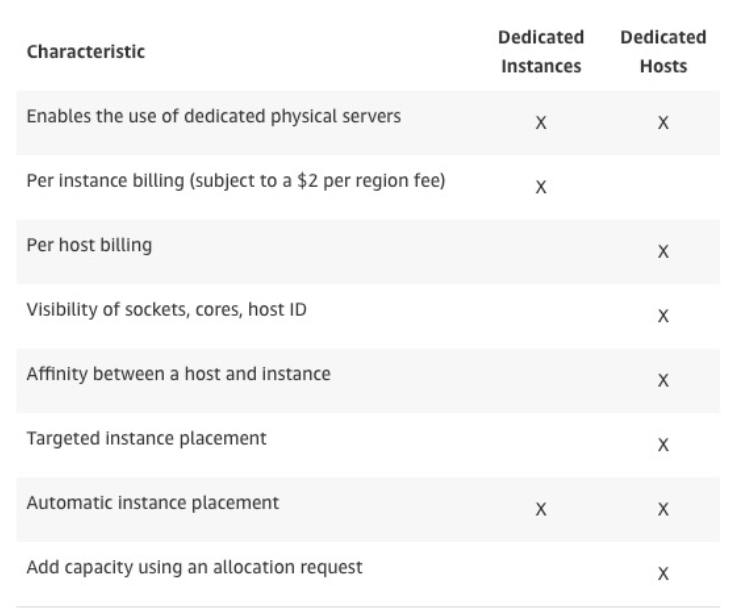
Host-instance affinity, BYOL ,Instance placement

 Techglot