Index
- Introduction
- Types of ML
- Based on level of supervision
- Based on mode of training
- Based on learning mode.
- Challenges in Machine learning
- Data collection
- Insufficient data/labelled data
- Non representative data
- Sampling Noise
- Sampling Bias
- Poor quality data
- Irrelevant features
- Overfitting
- Underfitting
- Software Integration
- Offline learning & deployment
- Cost involved
- Application of ML
- MLDLC – Machine Learning Development lifecycle
- Job Roles
- Data Engineer
- Data Analyst
- Data Scientist
- MLE
- Types of ML
- ML Implementation
- Data Structure – Tensors (0-D to 5-D Tensors)
- Tools and Lib for ML
- E2E flow
- Step by Step flow
- framing the problem & planing the project
- Netflix usecase
- framing the problem & planing the project
Introduction
Diagram – Hierarchy : AI , ML , DNN
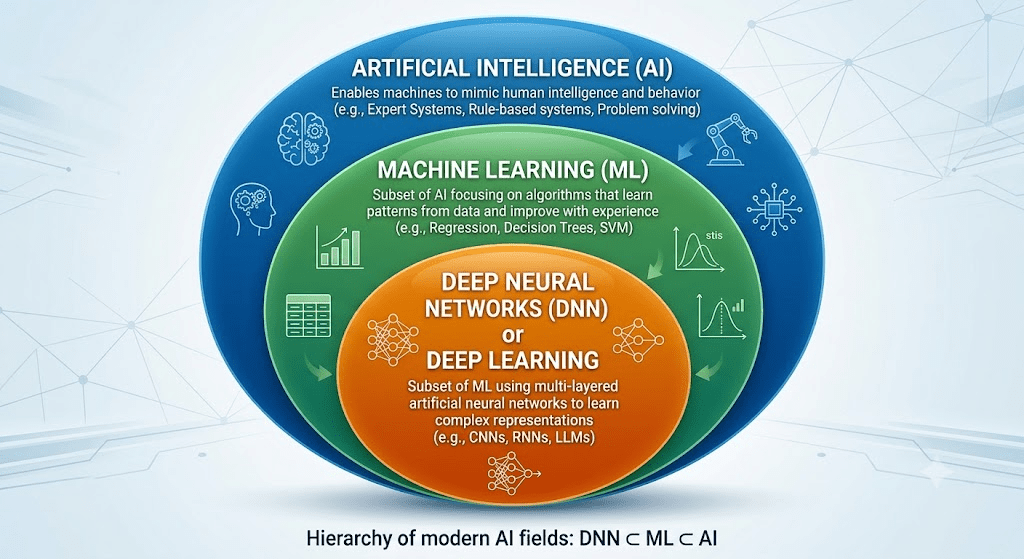
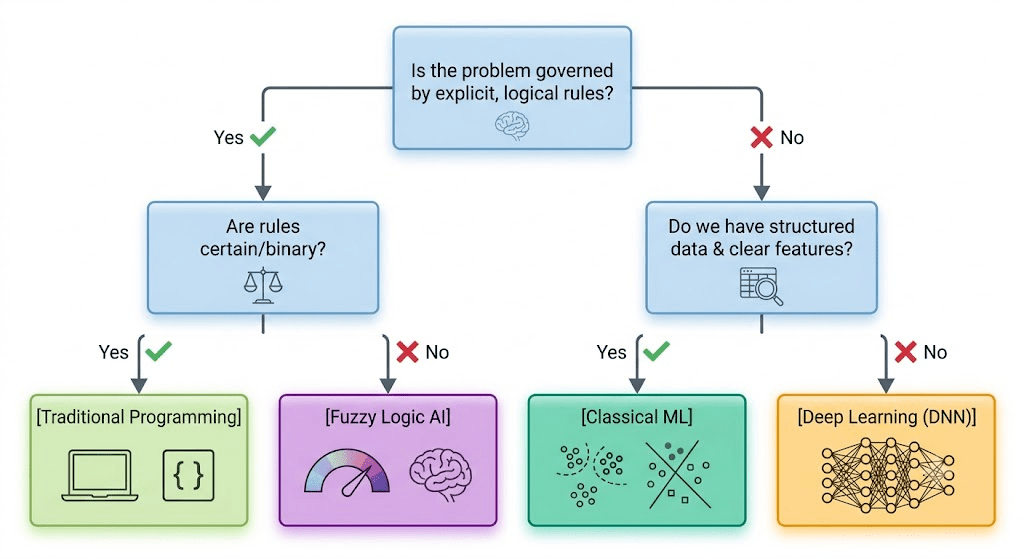
- Traditional programming – Crisp logic – You write an
if/elsestatement defining anything >30 °C as Hot. Crisp logic is a Traditional programming logic . No data needed. - AI is Rule driven which involves fuzzy logic (a human expert must still sit down and write every single rule ).No data needed.
- ML is data driven – then ML is helpful and data is requried.
- when we don’t have exact features then comes powerful DNN.
When to use which:
Types Of ML
Based on level of supervision:
- Supervised
- Regression – numerical
- Classification
- Unsupervised
- Clustering
- Anomaly
- Association
- Semi supervised
- Reinforcement
- reward/punishment mechanism
Based on mode of training:
- Batch/offline
- Offline learning of ML system
- When to use? no concept drift e.g. Classification
- cons – heavy size
- Online
- learning in small sizes – chuck of data – can be done on production environment.
- When to use?
- Concept drift e,g. stock market etc.
- Faster solution
Based on learning
- Instance based
- the system learns the training examples by heart. When a new data point arrives, it doesn’t look at a formula; it looks back at its memorized data and compares the new point to its closest neighbors.
- example –
- K-Nearest Neighbors (KNN). If you want to predict if a customer will default on a loan, KNN looks at the K closest customers in its database who have similar income/age and takes a majority vote.
- SVM – Support vector machine
- example –
- the system learns the training examples by heart. When a new data point arrives, it doesn’t look at a formula; it looks back at its memorized data and compares the new point to its closest neighbors.
- Model based
- the algorithm takes the training data, uncovers the underlying pattern, and condenses that pattern into a fixed mathematical formula (a model). Once the formula is created, the original data can be thrown away.
- Example- Linear Regression (y = mx + c) or Logistic Regression. Once the model learns the exact values for m and c, it deletes the training data from its memory. To predict y for a new x, it just runs that basic equation.
- the algorithm takes the training data, uncovers the underlying pattern, and condenses that pattern into a fixed mathematical formula (a model). Once the formula is created, the original data can be thrown away.
Challenges in ML
- Data collection
- Insufficient data/labelled data
- Non representative data
- Sampling Noise
- Sampling Noise (often called sampling error or variance) is the purely random fluctuation that occurs because you are looking at a smaller sample instead of the entire universe of data.
- Sampling Bias
- Sampling Bias occurs when your sample is collected in a way that some members of the intended population are less likely or more likely to be included than others. e.g from 4 countries only view of specific nationality person are taken on – which country will win cricket world-cup.
- Sampling Noise
- Poor quality data – 60% on time is consumed in correcting poor data – .
- Irrelevant features – Saying GIGO
- Feature engineering
- Overfitting
- Underfitting
- Software Integration
- Integration becomes difficult because not all libraries are natively supported in every other language which is used to run the software
- Offline learning & deployment
- Cost involved
Application of ML
- Product recommendation
- Chatbot
- B2B
- Retail (e-commerce)
- Before Sale – Predicting which skus will be most in demand
- Has huge impact financially if correctly predicted – not unnecessary stocking, if wrongly Out of stock issue
- Usually Companies maintain user profile based on buying interest. used in targeting marketing
- Positioning of products – Association rule (baby diapers and beer paper)
- Before Sale – Predicting which skus will be most in demand
- Finance
- Loan – profile is compared against past defaulters how many changes of overlapping criteria.
- Sharemarket
- Transportation
- Ola/Uber – Price surge. – “Prices are higher because of increased demand“
- Manufacturing (Tesla car)
- Predictive maintenance – based on input before product goes off , it is repaired
- Banking
- Social Media(Twitter)
- Sentiment analysis
- Retail (e-commerce)
- B2C
Machine Learning Development lifecycle
It has around 9 steps (Mind the sequence of 3->4->5 and onwards it comes as is):
- Frame the problem
- Data gathering
- Preprocessing
- Remove duplicates
- Remove missing values etc.
- EDA – Exploratory Data Analysis – EDA is how you find those patterns.
- univariate analysis
- Categorical Data: You use Bar Charts or frequency counts to identify class imbalances (e.g., checking if $95\%$ of rows are “Approve” and only $5\%$ are “Reject”).
- Numerical Data: You plot Histograms or Kernel Density Estimate (KDE) plots. You are checking for skewness (is the data normally distributed, or heavily shifted?).
- bivariate analysis
- Scatter Plots: To check if two numerical variables have a linear or non-linear relationship.
- Outlier detection
- univariate analysis
- Feature selection
- Feature combination – because more the feature more is the cost.
- Feature scaling
- Model Training, Analysis and selection
- ensemble learning – multiple algos combined to give better algo for a problem
- Testing
- Deployment
- Optimisation
Job Roles in the field
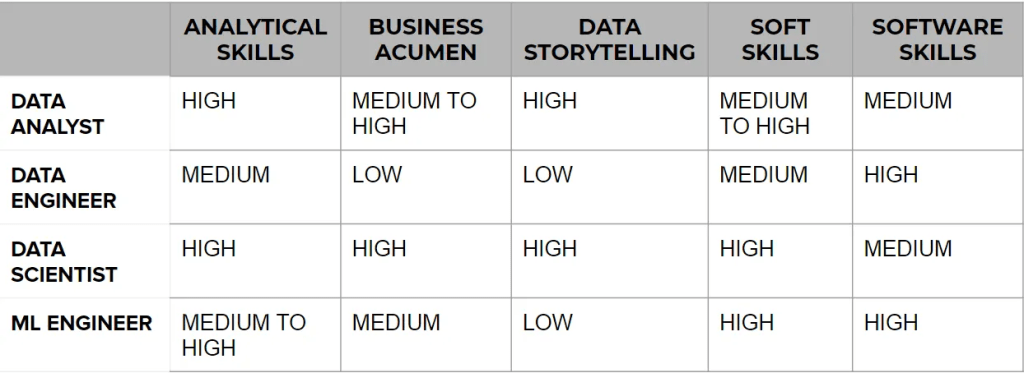
- Data Engineer – Core responsibility is fetching the data from different sources and making one warehouse for OLAP
- Data Analyst – More like Business Analyst but involve a bit more technicality.
- Data Scientist – Core responsibility is how to use the data for future business- where as DA gives the historical analysis, this role is more of a Full-stack kind.
- Machine Learning Engineer – Core responsibility Model optimisation and training , integrating with software , Data Optimisation and deployment of Model etc.
Conclusion :
 Techglot